
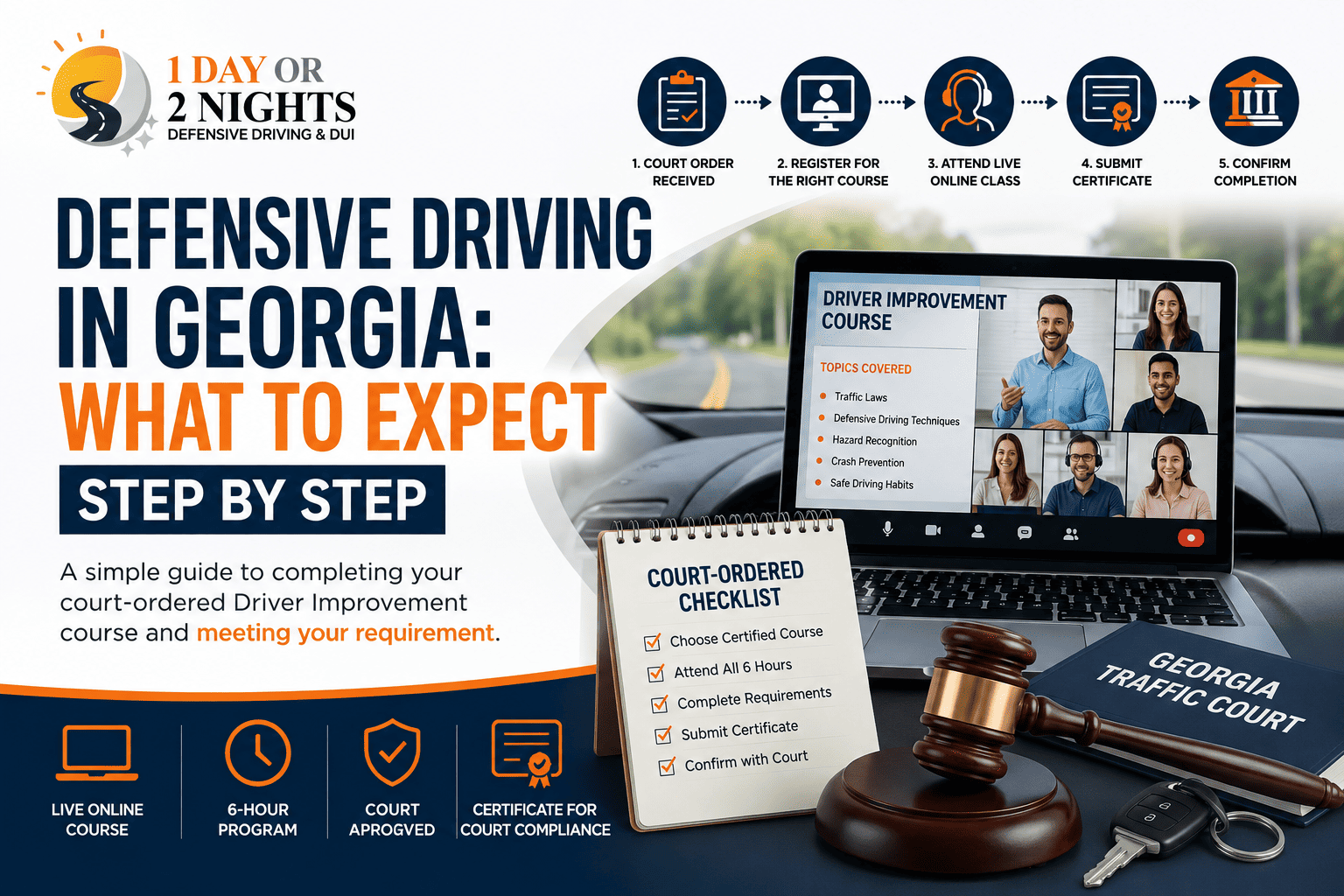
Defensive driving may be required by a Georgia court after certain traffic offenses.
If you have been ordered to complete a course, you may be wondering where to register, whether you can attend online, what happens during class, and how the court receives proof of completion.
Georgia commonly refers to the approved six-hour program as a Driver Improvement course. It focuses on safer driving behavior, traffic laws, hazard recognition, and crash prevention.
A court-ordered defensive driving class may be available through a live virtual format, but you should confirm the exact requirements before enrolling.
The steps below explain what to expect from receiving the court order through submitting your completion certificate.
What Is a Court-Ordered Defensive Driving Course?
A court-ordered defensive driving course is an educational program that a judge may require someone to complete following a traffic offense.
The purpose is to help the driver recognize risky behavior, understand traffic laws, and make safer decisions on the road.
Learning about common defensive driving mistakes can also help drivers recognize behaviors that increase the risk of traffic violations and preventable crashes.
The course does not teach the basic physical skills needed to operate a vehicle. Instead, it addresses subjects such as:
- Distracted driving
- Speed and vehicle control
- Safe following distances
- Driver attitude and awareness
- Traffic laws and road signs
- Crash-avoidance techniques
- Driving in poor weather
- Sharing the road safely
- Basic vehicle safety
The court handling your case determines whether you must take the course, when you must complete it, and how you need to provide proof.
Why Might a Court Require Defensive Driving?
A judge may order a Driver Improvement course in connection with a speeding citation, moving violation, unsafe driving behavior, or another traffic matter.
These violations can have even greater consequences for commercial drivers, so CDL holders should also understand what disqualifies you from getting a CDL in Georgia and how serious traffic offenses can affect their driving privileges.
The exact reason and requirement depend on the circumstances of the case.
In some situations, a driver may voluntarily complete the course before returning to court.
A judge or prosecutor may consider that effort, but completing the class does not guarantee that a ticket will be dismissed, a charge will be reduced, or a fine will be lowered.
Always follow the instructions from the court rather than assuming that another driver’s experience will apply to your case.
Step 1: Review Your Court Order
Start by reading every part of the court order or notice. Look for information about:
- The required course
- The completion deadline
- Whether online attendance is accepted
- The type of provider you must use
- Where the certificate must be submitted
- Whether the original certificate is required
The document may specifically require a Georgia-certified six-hour Driver Improvement course. If the wording is unclear, contact the court clerk before registering. Taking the wrong program could leave the requirement incomplete.
Step 2: Confirm That a Virtual Course Is Accepted
A live virtual class may be an option, but you should not assume that every online program will qualify. Courts may have specific rules regarding the provider, course format, and certificate.
Ask the court whether it will accept a live, instructor-led course conducted through Zoom. This differs from a generic self-paced course consisting only of recorded videos and online quizzes.
When contacting the court, have your case number and court order available. Ask for clarification about anything that could affect whether your certificate will be accepted.
Step 3: Select the Correct Course
Choose a school that offers the type of program named in your court order. In Georgia, this is commonly a court-approved defensive driving course consisting of six hours of Driver Improvement instruction.
Tell the school that your class is court-ordered and share the exact course wording from your documents. This helps the provider determine whether its program matches your requirement.
Do not confuse defensive driving with a DUI Risk Reduction course. They are separate programs with different content, schedules, fees, and completion requirements. If your documents mention DUI Risk Reduction, a standard Driver Improvement class may not satisfy the order.
Step 4: Register for a Class That Fits Your Schedule
1 Day or 2 Nights Defensive Driving & DUI offers a live virtual Driver Improvement course through Zoom. The required six hours may be completed in one day or divided between two scheduled nights.
The two scheduling options can help students work around employment, school, transportation, or family responsibilities. However, you must attend the complete schedule you select. You cannot combine partial sessions without the school’s approval.
Register early enough to finish the class and submit your certificate before the court deadline. Leaving the process until the final day creates unnecessary risk if you experience a scheduling or technology problem.
Step 5: Prepare for the Online Class
You can generally attend the live class using a smartphone, tablet, laptop, or desktop computer. Your device must have a working camera, clear audio, and a dependable internet connection.
Before class begins:
- Install or test Zoom.
- Charge your device or connect it to power.
- Confirm that the camera and microphone work.
- Find a quiet, well-lit place.
- Review the school’s attendance instructions.
- Keep any requested identification available.
- Plan to remain uninterrupted for the entire session.
Avoid attending while driving, working, or handling another activity that prevents your full attention. Virtual attendance carries the same participation expectations as an in-person classroom.
Step 6: Attend All Six Hours
The class is taught live by an instructor. Students examine common causes of traffic violations and collisions while learning practical ways to reduce risk.
The instructor may discuss how distraction affects reaction time, why following distance matters, how speed changes stopping distance, and how driver attitude can influence decision-making. Weather, vehicle condition, road hazards, and traffic responsibilities may also be covered.
Join on time, remain visible on camera, and participate as directed. Arriving late, leaving early, repeatedly disappearing from view, or failing to remain attentive may prevent you from satisfying the attendance requirement.
Because the program requires six hours, the instructor cannot shorten it for an individual student.
Step 7: Complete the Course Requirements
Follow the instructor’s directions throughout the session. Depending on the approved format, students may participate in discussions, review scenarios, complete exercises, or take an assessment.
The purpose is not simply to remain logged into Zoom. You must demonstrate active attendance and complete the required parts of the program.
If you experience an internet outage or technical problem, notify the school immediately. The provider can explain whether you can return to the session or need to reschedule.
Step 8: Review Your Completion Certificate
After successfully completing the course, you will receive a certificate. Review it before sending it anywhere.
Check that it includes the correct:
- Name
- Completion date
- Course information
- Provider details
Contact the school promptly if anything is missing or incorrect. An error could delay the court’s acceptance of your proof.
Keep a copy for your records, especially when the court or another organization requires the original certificate.
Step 9: Submit the Certificate to the Court
Completing the class does not always notify the court automatically. Follow the submission instructions in your court order.
Depending on the court, you may need to provide the certificate:
- In person
- By mail
- By email
- Through an attorney
- Through another approved process
Confirm whether the court needs the original or will accept a copy. Submit it before the stated deadline and keep evidence showing when and how it was delivered.
The course provider issues proof of completion, but the student is generally responsible for making sure the correct organization receives it unless told otherwise.
Step 10: Confirm That the Requirement Is Complete
Do not assume the matter is finished once you send the certificate. Contact the court to confirm that it received and accepted your proof.
Keep the certificate copy, delivery receipt, email confirmation, and the name of anyone who verified receipt. These records may be helpful if questions arise later.
Completing a course does not replace any other responsibility listed in the court order. You may still need to pay a fine, attend a hearing, submit documents, or meet another condition.
What Happens If You Miss the Deadline?
The consequences of a missed deadline depend on the court order and case. A late certificate could affect the handling of the ticket, fine, license matter, or another condition imposed by the judge.
Contact the court immediately if you realize that you cannot finish on time. Do not assume that late completion will be accepted or that enrolling before the deadline is enough. Courts generally look for successful completion and proper submission by the required date.
Will the Course Dismiss Your Ticket?
Completing defensive driving does not automatically dismiss a citation or remove a conviction. Only the court handling the case can decide whether course completion affects the charge, fine, or outcome.
If the violation has already resulted in points, an eligible Georgia resident may separately request point reduction through the Georgia Department of Driver Services (DDS).
Court compliance and DDS point reduction are different processes, even when the same certified course may satisfy both requirements.
A defensive driving course for CDL drivers may also help commercial drivers strengthen safer driving habits and demonstrate responsibility to employers, courts, and other organizations.
Common Mistakes to Avoid
Avoid these problems when completing a court-ordered class:
- Registering for the wrong program
- Choosing an uncertified provider
- Assuming any online course will qualify
- Failing to confirm virtual attendance with the court
- Waiting too long to register
- Joining late or leaving early
- Using a device without a working camera
- Forgetting to submit the certificate
- Assuming the school sends proof automatically
- Failing to confirm court acceptance
A few minutes spent verifying the requirements can prevent delays or the need to repeat a course.
Complete Your Defensive Driving Requirement Online
1 Day or 2 Nights Defensive Driving & DUI offers a live, six-hour virtual course through Zoom, available in one-day and two-night formats. Before enrolling, confirm that the course meets your court’s requirements and note the deadline for submitting your certificate.
FAQ
Can a Court-Ordered Defensive Driving Class Be Taken Online?
A live virtual class may qualify when the court accepts online attendance and the program meets its requirements. Confirm the provider and course format with the court before registering.
How Long Is a Georgia Defensive Driving Course?
The Georgia Driver Improvement course requires six hours of instruction. Depending on the available schedule, students may complete it in one day or over two sessions.
What Happens During an Online Class?
Students attend live instruction covering traffic laws, driver behavior, distraction, speed, road hazards, and crash prevention. They must remain visible, attentive, and present for the full program.
Does the Court Receive My Certificate Automatically?
Students should not assume that the school sends proof directly to the court. Follow the court’s submission instructions and confirm that the certificate was received.
Will Defensive Driving Remove My Ticket?
The course does not automatically erase or dismiss a ticket. The court handling the case decides whether completion affects the citation, fine, or charge.
What Happens If I Miss the Deadline?
A missed deadline may affect the outcome of your case or leave the requirement incomplete. Contact the court immediately for instructions instead of assuming late submission will be accepted.
Is Defensive Driving the Same as DUI Risk Reduction?
These are different programs. Defensive driving is a six-hour Driver Improvement course, while DUI Risk Reduction has separate content and requirements for DUI-related matters.
Can the Course Reduce Points on My License?
Eligible Georgia residents may request a reduction of up to seven points once every five years. The certificate must be submitted to DDS separately according to its requirements.